Showing posts with label Godey's Lady's Book. Show all posts

Sunday, May 6, 2012

Godey's Lady's Book - July 1875

As we approach summer, here's some summer fashion from 1875!  Interesting items, elephant-colored silk, bathing costumes for girls, boys and ladies, a wrapper for ladies in mourning and the "new" style of asymmetrical dress.  Once again, immense gratitude to the Providence Athenaeum for access to their spectacular archives and for making these images available!

By permission of the Providence Athenaeum

DESCRIPTION OF STEEL FASHION PLATE

Figure 1-Walking dress of two shades of purple silk.  The underskirt is of the lighter shade, trimmed with puffs; the overskirt and mantle of the darker, trimmed with bands of the lighter.  Hat of dark straw, faced and trimmed with silk to match dress.
Figure 2-Walking dress of écru-colored pongee.  The underskirt is trimmed with a kilt plaiting, headed with an embroidered band; the overskirt is finished with an embroidered band; sleeveless basque, covered with embroidery.  Chip bonnet, trimmed with black ribbon and blue corn flowers.
Figure 3-Dinner dress of a light shade of elephant-colored silk.  The lower skirt has the front breadth formed of kilt plaiting, and finished at the bottom by ruffles.  Sleeveless polonaise of lace of the same color, trimmed with fringe; it is cut square in the neck; silk sleeves.  The waist would of course have to be lined with silk.  Hair arranged in puffs, with feather clasped by a jeweled ornament arranged in front.
Figure 4-House dress of two shades of green silk and grenadine.  The underskirt is of silk, trimmed with a kilt plaiting; the overskirt and basque are of grenadine, trimmed with silk ruffles and ribbon; fringe around the edge of overskirt and basque.
Figure 5-Evening dress of pink silk, made with a trained skirt, the back breadths cut in turrets with a plaiting below them; the front breadth is even across the bottom with a plaiting deeper at the sides than the exact front, headed with puff, plaiting, and three rows of fringe; garlands of roses trim the skirt.  Low basque corsage, with bertha of a puff and fringe.  Hair arranged in puffs and curls, with roses between them.

By permission of the Providence Athenaeum

DESCRIPTION OF EXTENSION SHEET

First Side
Figure 1-Walking dress of écru and brown foulard.  The underskirt is of the brown, trimmed with ruffles of both shades.  The overskirt is of the light, with dark ribbon bows; light basque bodice, trimmed with folds of the dark.  Chip hat, trimmed with the two shades.  Dark brown parasol.
Figure 2-House dress of black silk and grenadine.  The underskirt is of the silk; the overskirt and basque bodice and sleeves are of grenadine, richly embroidered with silk and jet.  They are trimmed with silk and jet fringe.
Figure 3-Walking dress of gray camel's hair and silk; the underskirt is of silk, trimmed with puffs and ruffles.  The jacket bodice is of the camel's hair, trimmed with silk, with long sash ends falling down at the sides with pockets in them.  Hat of gray chip, trimmed with feathers and silk.
Figure 4-Carriage dress of lilac silk, trimmed with bands of darker silk, and sleeveless basque of the darker silk. The sleeves are of the shade of the skirt.  White chip hat, trimmed with two shades and white flowers.
FIgure 5-Walking dress of black grenadine.  The front breadths of underskirt are trimmed with folds; the back breadths with ruffles, headed with folds forming squares.  The overskirt is trimmed with a fold, the upper part in back being cut in scallops.  The basque is cut to correspond.  Black chip bonnet, trimmed with blue and black.
Figure 6-White chip bonnet, trimmed with white crêpe de chine and white flowers.
Figure 7-Hat of gray straw, trimmed with gray silk scarf and pink roses.

By permission of the Providence Athenaeum
Second Side
Figure 1-Bathing toilet of pale gray serge.  Trousers and short-sleeved blouse of gray serge, with bands of a darker shade.  Loose mantle striped gray and white flannel.
Figure 2-Bathing toilet for little girls.  Short trousers and blouse of white serge, braided with scarlet worsted braid.  Echarpe of scarlet Cashmere, with knotted fringe. White bathing slippers, with scarlet sandals.
Figure 3-Bathing toilet of bright blue flannel.  Trousers and blouse of flannel; the latter braided with white braid, and fastened with buttons.  Loose mantle of Baden-Baden cloth, bathing cap of oiled silk bound with blue.  Slippers with blue sandals.
Figure 4-Seaside toilet.  Skirt and sleeveless jacket of black taffetas; the former is plaited in front, and arranged in flounces at the back.  Tunic and bodice of striped batiste écru with guipure lace.  Necktie of lilac crêpe de chine.  Hat of écru-colored lawn, with gauze veil.
Figure 5-Costume for little boys.  Skirt of black and white tartan.  Jacket of gray tricot cloth, with bands and buttons.  White straw hat, with black gros grain ribbon.
Figure 6-Collar and habit shirt and sleeve of striped percale, trimmed with a narrow worked ruffle.
Figure 7-Bodice of white Nainsook muslin, trimmed with Valenciennes lace and muslin puffs.  This can be worn with a white or colored skirt.
Figure 8-Ladies' chemise, with yoke and narrow sleeves.
Figure 9-Linen collar and cuff; the collar is formed of four folds of linen.
FIgure 10-Little girls' apron, made of Nainsook muslin, and trimmed with lace insertion and edging.
Figure 11-Hat of black chip, turned up at one side, trimmed with cardinal red silk,and flowers of the same shade.
Figure 12-Bow for the hair and sash for evening dress.  The bow and sash are of plea pink ribbon, ornamented with bunches of lilies of the valley.
Figure 13-Piqué cloak for little girl, with braided cape.
Figure 14-Sleeveless basque of blue silk, trimmed with facing of quilted silk.  This can be worn over a white or black dress.
Figures 15 and 16-Front and back view of linen or wool dress for boy of four years, trimmed with braid and buttons.  Ribbon sash.
Figure 17-Ribbon bow for the hair, with jet butterfly in the center.
Figure 18-Cravat bow, made of pink crêpe de chine, and trimmed with either white or black lace.
Figure 19-Basque, made of black summer matelasse faced with black silk, open down the front, and joined by bows of ribbon.  This can be worn for the house or street with a black grenadine dress.
Figure 20-White straw bonnet, trimmed with black velvet and wheat, garland of roses inside the brim.
Figure 21-Childs' apron, made of white linen braided.
Figure 22-Dress for little girl of five years, made of blue lawn, with low square neck and short sleeves; underwaist of white Nainsook muslin tucked.
Figure 23-Kilt skirt and coat with vest for boy of four years, made of gray serge, or wash goods if preferred.  The vest if of white piqué.  Straw hat.

CHITCHAT
On Fashions for July

The little folks claim our attention first this month, not but what their fashions have been described over and over again in the descriptions given of their mamma's toilets, as they are the exact copies in miniature of those worn by older persons.

In infants' clothing little or no change is noticeable.  Infants' robes are still made very long, and with high neck and long sleeves.  The handsomest imported robes are made of organdy muslin, elaborately embroidered and edged with Valenciennes lace.  Simple robes are made of French Nainsook, and trimmed with insertion, edging, tucks, puffs, or crimped plantings edged with lace, as fancy dictates.  Infants' cloaks are not changed in shape.  These are, usually, for summer made of piqué in the form of two large capes, with elaborate embroidery on the upper cape.  Some persons prefer these to be made in Cashmere, and in very warm weather only have the upper cape worn.  Infants are generally put into short clothes when six months old, and the same patterns of larger sizes are usually worn until the child is four years old.  The dresses of boys and girls up to this age require the same patters, the only marked distinction in their wardrobe is in the head covering, as boys wear turbans, while girls have caps, close cottage bonnets, or fanciful round hats.

...

French Nainsook wrappers [for ladies] have Watteau backs, with tabliers of trimming and little round capes made of embroidery, insertion, and knife plaiting.  The tabliers are half circular rows of insertion and ruffling, or else lengthwise puffs.  Morning wrappers for ladies in mourning are trimmed with bias folds of the organdy laid in many parallel rows, and with knife plaiting.

It is now considered so necessary that the various shades of a lady's costume should match in the smallest detail, that skirt braided are made mixed, so as to match the various wool fabrics so popular for general wear.  These braids look much better than the plain ones, which formed a solid line of color around the edge of the skirt.  It is by particular attention to all these details that a lady's dress is made to reach perfection--everything to match and contrast, from the bonnet to the smallest detail of the costume.

Many of the dresses made at the leading dressmakers display he odd fashion of having one side so different from the other that they look like parts of two dresses put together by mistake.  Thus one side of the front will have the tablier representing three aprons, or perhaps, four; while the other is but one fully gathered tablier.


The full text of the engraved plates and the chitchat can be found in the images below!

By permission of the Providence Athenaeum

By permission of the Providence Athenaeum


Thursday, March 29, 2012

Godey's Lady's Book - June 1875

Another month!  June!  It's getting warmer...but all the ladies are wearing just as much clothing!  I went to Old Sturbridge Village one very warm summer day and was told by one of the historic interpreters, a woman in a very warm kitchen with a roaring fire upon which she was preparing some 1830-style food, that people assume the more clothes you wear, the hotter you are.  The reality, she said, is that in former times, wearing layers of light linen and cotton clothing actually kept you cooler.  She said she was quite comfortable in her layers.  An interesting side note...other interesting notes in this month's fashions, a beaded, braided belt, an effort to bring garnets back into fashion, and the proper management of the cumbersome but fashionable demi-train!

Thanks as always to the incomparable Providence Athenaeum for the gracious provision of these images and text.

By permission of the Providence Athenaeum
DESCRIPTION OF STEEL FASHION PLATE

Figure 1-Walking dress of two shades of brown silk.  The front breadth is formed of kilt plaits; the back breadths are plain.  Apron overskirt and sash of the darkest shade of silk.  Basque bodice, trimmed with the dark silk.  Chip hat, trimmed with silk and flowers.
Figure 2-Evening dress of two shades of blue silk.  The front of skirt is made of diamonds of the dark silk, with the lighter silk between them, plaiting at the sides; plain skirt in the back, with sash to correspond with the front.  Low corsage, buttoned up the front, with lace around the neck.  Hair arranged in finger puffs, with strings of pearls twisted around.
Figure 3-Visiting dress of two shades of purple.  The front breadth is formed of puffs and plaitings of the light shade upon the dark; the sides have pieces of the dark buttoned over; the back breadths are trimmed with a plaited ruffle, the upper part arranged in a pouf.  Basque bodice of the dark shade, with trimming and sleeves of the lighter.  Bonnet of the two shades of crape, trimmed with feathers and half wreath of leaves and berries.
Figure 4-Dinner dress of green silk.  The front breadth of skirt trimmed with puffs and white lace; the side and back breadths are plaited, the side ones, as well as the bodice, being trimmed with bands of velvet and velvet bows.  Basque bodice, surplice in the neck, plaited to match the skirt, and trimmed with lace and velvet; open sleeves, trimmed to correspond.
Figure 5-Evening dress of white muslin over pink silk.  The pink silk underskirt is trimmed with a plaiting.  Long apron overskirt of the muslin, and trained skirt in the back, trimmed with a  row of Mechlin lace, and a thick roll of muslin banded with pink ribbon; garlands of flowers upon each side.  Low corsage and short sleeves; the corsage of pink silk in the front, plaited white muslin in the back, and trimmed with lace.  Hair arranged in curls, with flowers to match those on dress arranged through them.
Figure 6-Dress for girl of six years old, made of gray summer Cashmere.  The skirt is trimmed with two ruffles bound with pink silk.  Basque bodice, trimmed with pink silk, and sash.  Gray chip hat, trimmed, with gray and pink.

Providence Athenaeum
DESCRIPTION OF EXTENSION SHEET

First Side
Figures 1 and 2-Front and back view of black silk house dress, made with shirred front, and sides divided by bands of silk or velvet; quadruple box-plait in the back of skirt.  Basque bodice, trimmed to correspond.
Figures 3 and 4-Front and back view of walking dress, made of gray silk; it is made with two skirts and a basque.  The underskirt is trimmed with a kilt plaiting on the front breadth, with bands of darker silk above.  The back is trimmed with a ruffle with a shirred puff above it.  The overskirt and basque are trimmed with the darker silk.
Figures 5 and 6-Front and back view of walking dress.  The underskirt is of brown silk, trimmed with three knife plaitings; the sleeves are of the same silk, trimmed to correspond.  The overskirt and sleeveless basque are of brown and gray plaid woolen goods, trimmed with brown silk.
Figure 7-Bonnet of gray chip, trimmed with gray velvet, feathers, and ribbon; lace ruche inside the brim, with pink ribbon bow and flowers in it.
Figure 8-Bonnet of white chip, faced with brown velvet, trimmed with blue silk and velvet, and feathers of the two colors; blue-bird in the face, and white illusion.
Figure 9-Lady's chemise, made square in the neck with puff with embroidered ruffle upon each side of it.
Figure 10-Infant's bib, made of piqué, trimmed with a muslin ruffle.
Figure 11-Sleeve for a silk dress of two shades of color.  The sleeve is of the darker shade and the cuff of the lighter, while the fringe and buttons are a combination of the two shades.  Above the cuff there are folds of silk, which terminate at the elbow with a bow of the two colors.
Figure 12-Brown chip hat, trimmed with brown silk and scarlet poppies, brown feather at left side.
Figure 13-Velvet necklet, with gilt ornaments.
Figure 14-Fraise of loops of black velvet and pink ribbon, with lace to be worn inside, fastened by a bird.

Providence Athenaeum
Second Side
Figure 1-Evening dress of pale blue silk, made with a sleeveless basque of matelassé, of a slightly darker shade; the neck and sleeves are trimmed with Mechlin lace.  Hair arranged in puffs and curls, with blue convolvulus arranged in it.
Figure 2-Dress of gray silk, trimmed with pink; white lace fichu.  Hair arranged in coil in the back with two long curls, and pink ribbon bow at the side.
Figure 3-Evening dress of pink silk, cut square in the neck; short sleeves, trimmed with black velvet and white lace.  Hair arranged in finger puffs, with tortoise-shell comb, and velvet band and flowers.
FIgure 4-Evening dress of white silk, with low corsage and short sleeves; bertha of white lace, wreath of roses trimming corsage.  Hair arranged in puffs, with half wreath surrounding them.
Figure 5-Fichu, made of silk to match the dress with which it is to be worn, or of a contrasting color; it is trimmed with lace.
Figure 6-Fichu and ruff for the neck, made of blue silk, trimmed with black lace and a narrow chain-stitched border; lace ruche inside around the throat.
Figure 7-White silk fan, painted with colored flowers, and edged with white lace.
Figure 8-Side and back combs, with ornamented tops of cut jets.
FIgure 9-Morning cap of white muslin, trimmed with a row of lace, black velvet band and loops.
Figure 10-Bège Cashmere costume for a girl of four.  The skirt is bordered with a plaited flounce, sewn on with a heading.  Round tunic, likewise edged with a plaiting, and looped up at the side with a bow and buckle.  High basque bodice, with coat-shaped sleeves.
Figures 11 and 12-Linen collar and cuff, fastened by a band of colored linen and buttons.
Figure 13-In our present illustration we give designs for a novel and beautiful style of handkerchief border.  The borders are of batiste écru, or, if intended for mourning, can be embroidered in black and white, the centre of the handkerchief being of fine cambric.  The embroidery is worked partly with colored thread or zephyr wool; partly with white embroidery cotton in satin stitch.  The outlines are worked around with buttonhole stitch.
Figure 14-White muslin morning cap, trimmed with lace; pink silk ruche, and bow and ends.
Figure 15-Suit for boy of four, made of dark-brown Cashmere; kilt skirt; sacque, trimmed with silk braid.
Figure 16-White cambric dress for child of three years, covered with English embroidery; it can be worn over an under slip of blue or pink silk, if desired.
Figures 17 and 18-Waistband of beads.  The beads are threaded on strong thread in equal lengths, and three rows for each strip.  Two sizes of beads are used, the middle row being larger than the others.  Figure 18 shows the mode of arranging the rows; these are then plaited together.  The band is finished with a ribbon bow; loops of beads and a swivel to hold the fan.
Figure 19-Costume for a girl of four years, made of gray Cashmere; kilt skirt, and sleeveless basque.  The skirt is trimmed with a band of blue silk, and the basque is made of it.
Figures 20 and 21-Brooch and earring of Bohemian garnets.  Fifty years ago garnets were extensively used for jewelry, but in recent times more precious stones have taken their place.  An attempt was made at the Vienna Exhibition to revive the taste of the public for garnet ornaments, and the Bohemian jewellers displayed many trinkets of this kind exquisitely designed and set.  Our illustrations represent some fine specimens, which may show that the brilliant red stone has been unjustly neglected.  As a comparatively cheap and effective gem, it certainly deserves the preference before colored paste.  The precious or Oriental garnet, from the River Syrian, in Pegu, however, is still much esteemed, its lustre and beauty placing it above all others.  But en cabochon it is called carbuncle; and another variety, from Siberia, is known as "gooseberry garnet."
Figure 22-Jet necklet.  The outside contour of this necklet is composed of several rows of small jet beads stitched together.  In the inside, the seven rows, which mount as a ladder upon the bodice, consist of single rows of beads, increasing in length as they ascend; while the double row, from which the cross is suspended, encircles the throat.  The necklet terminates with tassels of jet beads.
Figures 23 and 24-Front and back view of dress of girl of eight years, made of écru-colored serge, trimmed with one plaited ruffle on the lower skirt, with buttons fastening the plaits, overskirt and basque, with passementerie ornaments upon it, and up the front of the skirt.  Sash fastening overskirt in the back.
Figure 25-Boy's suit for boy of four years, made of dark-blue serge, and trimmed with braid and buttons.  Sailor hat of straw.
Figure 26-Dress for girl of six years, made of écru-colored batiste; the skirt is trimmed with narrow kilt plantings.  The bodice is low, with a basque, edged around the neck and sleeves with a narrow worked edging.
Figure 27 and 28-Front and back views of girl's walking costume, made of gray bêge, one skirt trimmed with a deep shirred ruffle; basque bodice, trimmed with a fold.
Figure 29-Necklet of passementerie, studded over with fine jet beads.
Figure 30-Chatelaine bag for ball toilet.  The bag is made of white stiff net, and lined with white sarcenet.  It is then covered with blue convolvulus of delicate shades and varied foliage.  It is mounted on ribbon that matches the toilet in color.  The fastening is at the side under a tuft of convolvulus.
Figure 31-Black silk fan, lined with pink.

CHITCHAT

On Fashions for June
We have heard so much of plainer toilets being adopted, that we imagined this spring would see the change effected.  On the contrary, we hardly ever remember more variety, more luxury, and a greater quantity of material used in a single costume than at present. As the season advances, we see fewer startling changes than we imagined there would be when we looked upon the bewildering masses earlier in the season.  We see little else but plaids and checks for parts of costumes; cuirass bodices are universal.  Skirts box-plaited at the back have taken, in a great measure, the place of poufs; and tunics that drape the figure so closely in front as to make one suspect that under garments are reduced to the smallest possible number and proportions are the prevailing style.

Our ultra fashionables have adopted the plan of wearing extremely short white underskirts, and of having the lower part of their train skirts trimmed inside with flounces of white muslin or cambric, so as to banish the long white skirt entirely.  This is not a bad plan, as the lining moves with the dress, which is not the case with the underskirt.  Demi trains have superseded the all round skirts, and all drapery about the skirt is soft and abundant.  Not a vestige of crinoline, no more than if such an institution had never prevailed.  These demi trains are very inconvenient for the street, as we have always said, and even for getting into a carriage, and they are so tied back and banded with elastic that walking, and, above all, sitting down, are not the easy, careless movements of yore.  Some dressmakers give instructions as to the management of these demi trains.  The best manner of gathering up the train is to turn to the right, bending slightly backwards, and to take hold of the dress as far down as possible with the right hand.  When your straighten and stand upright again, the skirt will be slightly lifted, and thus become no longer than a short costume.  WHen you wish to let the skirt trail again, you must throw it back with a sweep of the right hand.  This will be found a much more graceful way of preserving the train from contact with the streets than by lifting it on each side with both hands.


Wednesday, March 21, 2012

Godey's Lady's Book - May 1875

And here is May 1875--not coincidentally directly in line timing-wise with The Rebel Wife.  Augusta would have read this issue.  Some interesting things:  new hairstyles and references to the 17th century, very ugly Madras cottons, and the introduction of "beige".  Thanks as always to the sublime Providence Athenaeum.

By permission of the Providence Athenaeum.

DESCRIPTION OF STEEL FASHION PLATE

Figure 1 - Dress of light ecru colored batiste; the skirt formed of lengthwise puffs smaller in the back than front of skirt.  The sleeves are made to correspond, only the puffs run around the arm; brown silk cuffs, and brown silk sleeveless jacket, double breasted.  Ecru-colored chip bonnet, trimmed with silk, feathers, and colored roses.

Figure 2 - House dress of gray silk, the front breadth trimmed with puffs, and plantings finished at the sides with bows.  The back has one puff and a plaiting and a long overskirt.  Blue silk body, trimmed with cord and ornaments.

Figure 3 - Evening dress of white and pink silk.  The underskirt is of the white silk, trimmed up the front and on the back of skirt with narrow lengthwise ruffles and pink ruches.  Low basque bodice and overskirt of pink silk, trimmed with white lace and black velvet.

Figure 4 - Dinner dress of green silk.  The front breadth is formed of kilt plaits, with bands of darker green silk, with ornaments at the ends crossing it.  The back breadths are ruffled to the waist.  The sides are trimmed with the darker silk, as are also the sleeves.  The bodice is a plain cuirass basque, with sleeveless basque of black lace over it.

Figure 5 - House dress of lilac silk, with the front breadth trimmed with narrow ruffles, the back breadths trimmed with a deep ruffle with a band of darker silk above it.  Overskirt at the sides and back.  Cuirass basque, cut surplice, with standing ruffs of white muslin inside.  Sleeve slightly open, and formed of lengthwise puffs.

Providence Athenaeum

DESCRIPTION OF EXTENSION SHEET

First Side
Figure 1 - Dress of two shades of lilac silk.  The front breadth is trimmed with a deep kilt plaiting, the back breadths with a narrower one and ruffles.  The long apron in front is trimmed to simulate three skirts with the darker shade.  The jacket bodice is of the darker, trimmed with pockets, band and bows of the lighter.  White chip bonnet, trimmed with two shades of lilac.

Figure 2 - Dress for traveling, of gray tweed, made with long straight overskirt perfectly plain.  Basque jacket, open in the back of the skirt, with buttons and buttonholes down the sides.  It is trimmed with black braid, as are the seams of the back.  Gray straw hat, trimmed with bird and feather and silk.

Figure 3 - Walking dress of two shades of brown.  The underskirt is of silk, trimmed with five ruffles, and a pouf in the back.  The polonaise is of summer Cashmere, with a long apron front, and short back merely like a basque, trimmed with a band of silk.  Brown chip hat, trimmed with silk, long feather , and flower.

Figure 4 - Walking dress of gray and black silk.  The front breadth is puffed of the gray silk; the revers at the side are of the black; two black and two gray ruffles trim the back, the rest is of gray.  Black summer matelassé sack, trimmed with gray feather band.  Black hat, trimmed with gray.

Figure 5 - House dress of striped and plain silk.  The front breadth is of blue and gray striped silk, trimmed with two bias folds, with a band of gray feathers above them.  The back breadths are plaited; they, the sleeveless bodice and apron overskirt, are of plain gray.  The sleeves are striped, and are trimmed to match the overskirt with lace and feathers.

Figure 6 - Evening dress of pale green silk, made with one skirt, the sides trimmed with two rows of lace, and loops of wide ribbon and ends; deep basque bodice, cut surplice in the neck; short sleeves, trimmed with lace and ribbon loops and ends.

Figure 7 - Hat of gray chip, trimmed with gray silk, feather, and steel buckle.

Figure 8 - Bonnet of black lace, trimmed with long blue feather and ribbon.

Figure 9 - Bonnet of black chip, trimmed with green feather, ribbon, and black lace, pink roses inside the brim.

Figure 10 - Bonnet of white chip, trimmed with black velvet, feather and pink roses.

Figure 11 - Bonnet of brown crape, the crown covered with spotted net, and trimmed with ribbon and aigrette.

Providence Athenaeum

Second side
Figures 1 and 2 - Evening coiffures.  The front hair is cut short and curled à la Reine Henriette across the forehead.  Behind this a piece of hair is turned back over a frizette.  The side-pieces are also rolled back over frizettes, and the back hair is twisted into a knot, ending in a loose curl.  See fig. 2.

Figures 3 and 4 - Indoor coiffure.  Part the hair in the middle, comb it back, and arrange it on the head in loops over small frizettes.  The back hair is arranged in hanging plaits, which, if false, are headed by a bow of ribbon.  See figure 4 for back of coiffure.

Figure 5 - Bracelet of jet beads threaded on elastic and ornamented with jet medallions.

Figure 6 - Neck bow of pink crêpe de chine, white lace, and pearl buckles.

Figure 7 - Chemisette and standing ruff to wear with a surplice dress.

Figure 8 - Walking dress for little girl of five years oils, made with a cape of white piqué, and finished all around the edge with English embroidery.

Figure 9 - High buttoned boot of kid, stitched with white.

Figure 10 - Coronet of rosettes, made of jet beads, fastened on to a slender wreath of cut jet.

Figure 11 - Infants' long robe, trimmed with vandyked embroidery put on en tablier, and around the bottom.

Figure 12 - Apron of gray linen, braided with chain stitch of white thread, and surrounded with white worsted braid.

Figure 13 - White muslin apron.  Trimmed with a frill of the same material, and with white lace.  Above the frill is a vandyked trimming of batiste, trimmed to correspond.

Figure 14 - High kid shoe for house or street wear.

Figures 15 and 16 - Front and back view of jacket to correspond with.

Figure 17 - Boys' waistcoat and trousers of gray summer cloth, ornamented with braid and buttons.

Figure 18 - Bonnet of black chip, trimmed with a scarf of pale pink silk, feather and flower inside the face.

Figure 19 - Bonnet of white straw, trimmed with pale and dark blue ribbon and feather.

Figure 20 - Ornamental pearl pins for the hair.

Figure 21 - Ladies' chemise, with yoke, made with lengthwise insertion and tucks, with plaited pieces forming scallops coming below.

Figures 22 and 23 - Front and back view of morning dress, made of white or colored Cashmere, trimmed with one ruffle around the bottom of skirt, headed with two narrow standing ones, and two bands, which also trims the front cuffs and pocket.


CHITCHAT
On Fashions for May

As the new spring suits each daddy appear, there does not remain a doubt but that all overdresses, such as polonaises, redingotes, tabliers, and basque bodies, will be quadrille, as the French term it; in plain English, they will be checks or plaids, for squares have evidently taken he place of stripes.  Some few of the newest costumes are made entirely of the plaid material, but, for the most part, it is judiciously mixed with plain faille.  The plaids are not regular; they do not look like even checks; on the contrary, they are broken and crossed with lines, more like the plaid patterns on tartan scarfs than plain checks.  There is ag rest variety in the designs, and, as a rule, the checks are somewhat large; they are either a very dark color, with white, or else some shade of bêge.  A few contain three colors, such as brown and gray, with a prune stripe, pale blue, dark blue, and écru.  Some of the new plaid materials too closely resemble the patterns on Madras cotton handkerchiefs to be pretty; consequently care should be taken in selecting, as we can conscientiously say some of the goods seen are the ugliest we have ever had occasion to look at. The newest Lyons silks are fails of medium reps, and of very dark shades; mixed and eccentric colors have disappeared, and given place to more natural hues, browns and grays predominating decidedly in quantity.  The natural soft browns are called beige color, and these range from noisette to a creamy white tint.


Monday, March 12, 2012

Godey's Lady's Book - February 1875

Once I'm on a roll, I like to keep it rolling.  Here's February!  Hope you enjoy it!  Some of my favorites include the detailed description of a new and fashionable hairstyle, including images to help, and a very reluctant discussion of children's clothes in the Chitchat!  Huge thanks to the Providence Athenaeum for these materials from their collection!

By permission of the Providence Athenaeum

DESCRIPTION OF STEEL FASHION PLATE

Figure 1 - Visiting dress of green gros grain silk, made with two skirts and basque bodice.  The lower skirt is trimmed with a kilt plaiting in the back, headed with a ruffle and band of the silk embroidered.  Apron overskirt, with sash ends trimmed with the same style of ruffle and band.  Basque bodice; open sleeves finished with a silk cord.  Green velvet bonnet, trimmed with feather, ribbon, and flowers.

Figure 2 - Walking dress of two shades of brown silk and Cashmere.  The underskirt is of the lightest shade of silk.  The overdress and bodice are of the darker shade of Cashmere, trimmed with fringe and passementerie.  Bonnet of velvet of the two shades, trimmed with a long feather.

Figure 3 - Dinner dress of two shades of plum-colored silk.  The underskirt is of the lighter; the front breadths trimmed with a knife plaiting of the darker silk; the back breadths with two ruffles, trimmed to correspond with the front.  Polonaise of the darker silk, with trimming of the lighter silk; light and dark ribbon sash ends and bows.

Figure 4 - Evening dress of two shades of blue silk.  The dress is composed entirely of the light, with the trimming of the darker.  The underskirt is trimmed with a kilt plaiting in alternate plaits of the two shades; the apron overskirt is composed of lengthwise puffs divided by ribbon bows, and finished with scallops and fringe at the edge; the sides are formed of folds of the two shades; pouf in the back; sash.  Jacket bodice; coat sleeves of the darker silk.

Figure 5 - Evening dress of pink silk, made with two skirts.  The lower one is formed of lengthwise puffs with two ruffles around the bottom of skirt.  The overskirt is apron front, puffed in the back, trimmed with Valenciennes lace and garlands of flowers.  Low corsage, with bretelles of lace and flowers; inner waist of muslin and lace.  Hair arranged in puffs, with flowers to match dress.

Figure 6 - Party dress for child of five years, made of white alpaca.  The front breadth is trimmed with bands of pink silk, the back breadths with a ruffle of the silk.  Pink silk overskirt, long at the sides and going up shorter in the back.  Waist trimmed with a bertha of pink silk.

Providence Athenaeum

DESCRIPTION OF EXTENSION SHEET

First Side
Figure 1 - Visiting dress of black velvet.  The underskirt is plain; the polonaise is trimmed with lace and ribbon loops down the back of skirt, and is edged all around with lace.  Black velvet bonnet, trimmed with feather and pink roses.

Figure 2 - Walking dress of seal-brown camel's-hair, made with underskirt and polonaise, trimmed with fur fringe.  Bonnet of brown velvet, trimmed with feather, lace, and ribbon; spotted lace veil.  Muff to match the fur in fringe.

Figure 3 - This costume may be made either of blue serge or the lighter make of homespun.  The trimmings are black Titan braid and black japanned buttons.  The demi-fitting jacket opens slightly heart-shaped in front, and has an upright frill of the same lined with silk.  The pockets on the side pieces are lined with silk and trimmed with braid.  Braid is laid on the sleeve to simulate a deep cuff; a gathered flounce with heading borders the skirt, over which a tunic is draped.  The tunic is long in front and short at the back.   Hat of dark blue felt, trimmed with velvet and feather.

Figure 4 - Black silk and Cashmere costume.  The underskirt is of silk, trimmed with two box-plaitings.  The overskirt and sleeveless basque are of Cashmere braided all over; silk sleeves.  Black velvet hat, trimmed with silk and feather.

Figure 5 - Plum-colored silk and velvet costume.  The underskirt is of silk; the front breadth trimmed with a large box-plait and buttons; the back breadths with a deep puff and narrow ruffles.  Velvet overdress and sleeveless basque; silk sleeves and vest.  Bonnet of silk and velvet, trimmed with feather and flowers.

Figure 6 - Walking dress of gray Cashmere.  The front breadth is trimmed with plaitings; the back breadths with three ruffles.  Cloak made of heavy cloth the color of dress, trimmed with velvet and fringe.  Gray felt bonnet, trimmed with velvet and feather blue inside.

Figure 7 - Echarpe of black gros grain ribbon six inches broad, attached to a waistband of the same material, and held in place by a clasp, as shown in our illustration.  The two ends are richly embroidered.  The flowers and stems are worked with purse silk, the natural color, in satin, overcast, knotted stitch, and point russe.  A heavy fringe five inches deep completes the echarpe.

Figure 8 - Echarpe of blue corded ribbon, attached to a waistband of the same material, and trimmed with black beaded insertion and lace.  The large bow is clasped by a passementerie agraffe.

Figures 9 and 10 - Blue steel aigrettes for bonnets and hats.

Figure 11 - Jet arrow for the hat or the hair.

Providence Athenaeum

Second Side
Figures 1 to 5 - The Virgile headdress, with comb. This simple morning headdress consists of torsades of hair fastened up with a comb, patented by M. Virgile, a Paris hairdresser. Fig. 2 represents the right side of the coiffure, and Fig. 4 the left side; Figs. 3 and 5 show the manner of arrangement.  First, part the two portions of hair which are to be waved or crêpe, then fasten in the comb at the back by means of a strand of hair, which should be twisted around and around.  If there is sufficient natural growth, it is used for the torsades that cross the interlace between the teeth of the comb.  But when the natural growth of hair is scanty, false torsades are slipped into the teeth of the comb.  A long curl is added at the back of each ear.

Figure 6 - Under-waist of cambric muslin, trimmed with tucks put on in points, edged on each side with a narrow edging.

Figure 7 - Jacket for girl of five years, made of gray cloth, scalloped and braided with black braid.

Figure 8 - Fancy bow for the hair, made of plain pink and figured silk, with a small white wing, and steel buckle and arrow in the centre.

Figure 9 - Cape made of French muslin puffs, divided by lace insertion, and trimmed with muslin ruffle, edged with lace.  Fraise around the neck, colored ribbon bow fastening it.

Figure 10 - Chemise for young lady: the yoke formed of lengthwise tucks, with insertion put on in scallops below it.

Figure 11 - Waist for ladies' dress; trimmed with Titan braid in rows, graduated both in the back and front; the sleeves are trimmed to correspond.

Figure 12 - Linen collar, trimmed with narrow braid; cravat of colored silk, trimmed to correspond.

Figure 13 - Velvet necklet, ornamented with jet, and jet locket hanging from it.

Figure 14 - Silver waistband, formed of medallions joined with chains.

Figure 15 - Cravat scarf of blue silk, with ends of Valenciennes lace inserted, and a row of lace edging it all around.

Figures 16 and 17 - Habit shirt and sleeve, with double ruffle of plaited muslin around the throat, a wider ruffle around the wrist.

Figures 18 and 19 - Front and back view of gymnastic costume for a girl of seven years, made of striped woollen goods, and trimmed with braid and buttons.

Figure 20 - Linen cuff, with frill.

Figures 21 and 22 - Habit shirt and sleeve of the fashionable shape, made of linen, edged with lace.

Figure 23 - Corset cover, made of Nainsook muslin, formed of lengthwise puffs, divided by worked insertion; the neck and sleeves are trimmed to correspond.

Figures 24 and 25 - Front and back view of dress for girl of ten years, made of brown serge.  The skirt is plain, trimmed with tabs on each plait, bound with braid; basque bodice, sash bows and ends in back.

Figure 26 - Bonnet of blue velvet, trimmed with ribbon, feather, and spray of pink roses.

Figure 27 - Hat of gray felt, trimmed with gray velvet and feather.


CHITCHAT

On Fashions for February
The little folks claim our space and attention first this month. We have had so much to discuss in the way of fashions for the older home members, that they have not had any very lengthy space devoted to them and we really have given so many designs for children's clothing as to leave but little for us to tell; but our readers seem to think they would like us to devote some space to chatting about their darlings, so we will endeavor to find something new to talk about.

Brown is the fashionable color for children's clothing this winter.  Dark seal and nut-brown shades are chosen, and appear in the bonnet, wrap, sash, and stockings.  Where white dresses are still worn by the little ones, these are the stylish accessories to them; when dark dresses are worn, the entire costume is brown.


As always, the full chitchat can be read in the below attachments.


Sunday, March 11, 2012

Godey's Lady's Book - January 1875

This is the first in a hopefully long series of posts of issues of Godey's Lady's Book.  I will try to include all the fashion plates, their descriptions and the description of the latest styles from Paris and New York.  Truly fantastic!  I hope everyone enjoys looking at them and maybe some of you will find them useful for research as well.  Immense and eternal thanks to the Providence Athenaeum for working to scan these from their amazing collection.

Thanks to the Providence Athenaeum


DESCRIPTION OF STEEL FASHION PLATE

Figure 1 - House dress of black silk, made with one skirt.  The side breadths are trimmed with kilt plaiting from the waist, with bands of silk crossing them, bound with silk of the new cardinal red; puff in the back of the skirt; jacket bodice, trimmed to correspond; open sleeves, with puffs on top.
Figure 2 - House dress, made of two shades of green silk.  The underskirt is trimmed with narrow ruffles; the polonaise fastens over at one side, and is trimmed with a ruffle and band; the neck is cut surplice; open sleeves, with puffs at top of arm.
Figure 3 - Evening dress of pink and white silk, made court train.  The front breadth is formed of apron and ruffle of white silk embroidered, trimmed with wreaths of foliage laid in ruches of lace; low corsage, with bertha to correspond.
Figure 4 - Dinner dress of two shades of purple and lilac silk.  The underskirt is of the darkest silk, trimmed with one ruffle, piped with the lighter at both top and bottom; three narrow folds head it at the top; apron overskirt of the lighter silk, with two box-plaited ruches for trimming; long pointed basque waist of the darker silk, cut surplice; coat sleeves, trimmed to correspond.  Sash in the back.
Figure 5 - Walking dress of two shades of brown silk.  The underskirt is of the two shades of silk, the ruffles and plantings being of the lighter; the jacket waist is deep on the sides and front, and is trimmed with the lighter silk; coat sleeves, with cuffs.  Bonnet of the two shades of velvet, trimmed with a long feather.
Figure 6 - Dress for child of four years.  Dark blue silk blue poplin dress and cloak, trimmed with Duchesse lace.  Blue velvet hat, trimmed with white and blue feather.

Providence Athenaeum


DESCRIPTION OF EXTENSION SHEET

First Side
Figure 1 - Walking dress of brown Cashmere.  The underskirt is trimmed with folds on the front breadth, the back breadths with three ruffles; the overskirt and jacket bodice are simply stitched.  Bonnet of brown felt, trimmed with flowers and velvet.
Figure 2 - Morning dress of dark blue and gray striped Cashmere, trimmed with pointed bands of blue silk up the front.
Figure 3 - Walking dress of black silk.  The front breadth is trimmed with one deep ruffle.  headed with diagonal puffs; lengthwise puffs down the sides, fastened with ribbon bows; long overskirt in the back.  Black cloth jacket, with revers and cuffs of black velvet.
Figure 4 and 6 - Front and back view of house dress of black Cashmere, made with polonaise and underskirt, trimmed with side-plaited ruffles.
Figure 5 and 7 - Front and back view of house dress of navy blue serge.  The back breadth is trimmed with three ruffles; the apron overskirt with three narrower ones; jacket bodice, trimmed to correspond.
Figure 8 - Dinner dress of two shades of lilac silk.  The underskirt is of the darker shade, and is plain; the apron overskirt and bodice are of lighter, and can be trimmed with either white or black lace, to suit the taste of the wearer.
Figure 9 - Walking dress of brown silk and camel's hair.  The underskirt is of the silk of a dark shade, trimmed with one deep ruffle and puffs; the overskirt and basque is of the camel's hair, trimmed on the front with velvet bands, and cuffs and collar to correspond.  Brown felt hat, trimmed with velvet.
Figure 10 - House dress of gray and black striped poplin, trimmed with ruffles of the same; sleeveless basque of black velvet.
Figure 11 - Walking dress of black silk.   The front breadth is trimmed with ruffles, the back breadths are plain; jacket with revers, and flaring cuffs of black velvet.  Black velvet hat, trimmed with bird, and lace veil to fasten around the throat.

Providence Athenaeum

Second Side
Figure 1 - Dress for girl of seven years, made with underskirt and polonaise.  The underskirt is of gray Cashmere; the polonaise of blue, trimmed with fringe and a band of silk.  Hat of gray felt, trimmed with blue velvet.
Figure 2 - Dress for girl of six years, made of two shades of brown serge.  The dress is made of the lighter shade, trimmed with ruffles and revers of the darker.
Figure 3 - Suit for boy of eight years, made with Knickerbocker pants, and blouse fastened with a belt.
Figure 4 - Dress for girl of ten years, made of two shades of green.  The underskirt is of silk; the polonaise, which is long in front, is of Cashmere, trimmed with bands and small points of silk.
Figure 5 - Suit for boy of five years, made of black velvet, and trimmed with silk braid and buttons.
Figure 6 - Walking dress for girl of six, made of navy blue Cashmere.  The underskirt is trimmed with one ruffle, edged with three rows of narrow velvet; the overskirt and basque are trimmed with the velvet alone.  Blue felt hat, trimmed with velvet and wing.
Figure 7 - Bonnet of blue velvet, trimmed with flowers, ribbon, and feather.
Figure 8 - Hat of gray felt, trimmed with black velvet, feather and jet ornament.
Figure 9 - Bonnet of black velvet, trimmed with jet and leaves, silk, and colored wing.
Figure 10 - Hat of dark navy blue felt, trimmed with velvet and steel ornament.
Figure 11 - Evening coiffure, formed of plaits and short curls over the forehead.
Figure 12 - Linen apron, with bib and pocket, for girl of ten years, trimmed with a ruffle, edged with lace.
Figure 13 - White muslin fichu, trimmed with plantings of the same.
Figure 14 - Fashionable linen collar, and undersleeve to match
Figure 15 - Gentleman's silk cravat, made of black silk, spotted with crimson.
Figure 16 - Velvet bracelet, to match necklet.
Figure 17 - Black velvet necklet, with bow and long ends.
Figure 18 - Mantle of black velvet, trimmed with jet galloon and lace.
Figure 19 - Fichu of black and white lace, with Marguerites through the centre.
Figure 20 - Ladies' fashionable kid walking boot.
Figure 21 - Fashionable linen cuff, edged with lace.
Figure 22 - Breton collarette of black velvet, with silver ornaments across.
Figure 23 - Ladies' cloth sacque, trimmed with jet braid, buttons, and jet and silk fringe.
Figures 24 and 25 - Girl's cross-over fichu and tablier.  This style of garment, made in woolen materials, will be much worn by girls from seven to fourteen years of age.  Our model is made of blue serge flannel, and is trimmed with a blue woolen fringe, with a fancy heading streaked with color.  The tablier is draped at the sides, sewn to a waistband, and fastens at the back.  The fichu roses over the chest, and the end turns back with a revers.
Figure 26 - Black velvet bodice, trimmed with blue jet ornaments and feather trimming.
FIgures 27 and 28 - Front and back view of dark blue cloth dress, braided, for child of three years.
Figures 29 and 30 - Front and back view of dress for girl of eight years of age, made of brown diagonal serge.  The underskirt is trimmed with two ruffs; the overskirt and jacket bodice is trimmed with narrow piping folds.
Figure 31 - Fashionable kid boot, buttoned, and stitched with white.
Figure 32 - Evening coiffure, composed of braids and puffs, with a bow of ribbon and a rose at the right side.
Figures 33 and 34 - Front and back view of black velvet sleeveless polonaise, embroidered with jet and silk, and trimmed with lace.

The chitchat was the section where the fashion editor recounted the latest fashions, seen on the streets of New York and Philadelphia, or the showrooms of the finest purveyors in those cities, or direct from correspondents in Paris.  I will include the beginning, the remainder is accessible through the text images below.

CHITCHAT

On Fashions for January
We do not think we can better commence our greeting to our readers of 1875, than by speaking of some of the many beautiful novelties in jewelry seen, and which would be particularly beautiful and appropriate as gifts at this season, merely, however, warning our readers that, unfortunately, like all beautiful articles, they are not within the reach of all.  Accompanying a superb necklace, in which the diamonds were graduated in size, was a pendant of heart-shaped diamonds surrounding a heart-shaped emerald; from this was suspended a similar shaped large emerald set in diamonds.  With this magnificent and costly ornament were ear-rings to correspond.  Enamelled in gold, in brilliant colors, are setts for pendant and ear-rings of Medicis portraits.  The high, full ruffs, jewels, and headdress of those days are exquisitely painted.  The new styles of necklaces are oblong squares of yellow, finely-pierced gold; connected by slender bars between each one, hang red gold balls cut in diamond facets.  The ear-rings, in corresponding gold, are made like stars, and attached to this set is a massive cross of pierced gold, set with red gold studs.  Another equally massive style is of interlocked bars of red gold.  New watch chains are in slender links of gold, caught together by lovely large pearls and bars of tinted gold.  We have also seen Leontine watch, with square chatelaine chains, bars, slides, and locket, superbly enriched with flowers in gold of four colors.

Providence Athenaeum

Providence Athenaeum

Tuesday, October 4, 2011

Mourning Fashionably c. 1865

Unidentified woman wearing mourning brooch and displaying framed image of
unidentified soldier, Library of Congress
Custom and social ritual dominated life in the 19th century in a way that we find often difficult to access and understand today.  There is no ritual that holds more fascination for us moderns, nor that still is surrounded by more remnants of old practices, than that of mourning.  I have written here about the rise of embalming and will soon get back to the services provided by undertakers, but now I'd like to spend a little time discussing some of the fruits of my research into the fashion of mourning in the Godey's Lady's Books of 1864 and 1865.
Unidentified girl in mourning dress holding framed photograph of her father as a cavalryman
with sword and Hardee hat, Library of Congress
As Drew Gilpin Faust notes in her amazing book This Republic of Suffering, 18 percent of white males of military age in the South died in the war.  The death rate in the North was one-third that of the South, but death and loss were omnipresent parts of daily life throughout the country.  Due to scarcity or the overwhelming rush of death, some mourning practices may not have been followed, but it was nonetheless important for people, regardless of economic resources, to show their grief through dress.  The ritualized function of mourning dress was a visible representation of their loss as well as a cathartic process.
Mourning card, In memory of Abraham Lincoln, Library of Congress
In 1875, Harper's Bazar published "The Bazar Book of Decorum: The Care of the Person, Manners, Etiquette, and Ceremonials."  In it, they say this about mourning customs:
We have shown the good taste in America of abolishing the hired mutes, the emblazonment of the emblematic horrors of death, the skull and cross-bones on the panels of the hearse, and all that "luxury of woe" so remarkable in English funerals.  We have borrowed from the French and Germans the tasteful practice of the use of flowers.  This, however, with our usual tendency to excess, has become immoderate, and there is often an ostentatious exhibition of a profusion of crowns, crosses, hearts, and stars of the rarest and most costly products of the hothouse, which seem rather an indication of the exultation of wealth than of a regret for the dead or sympathy with the living. 
The notice of a death and the invitation to the funeral are conveyed through the newspapers to the friends and acquaintances generally, but notes are sent to those who are to serve as pallbearers.  In this country ladies occasionally, but in England never, follow the procession, and the female members of the family not seldom make their appearance in company with the male chief mourners.
It is now beginning to be the custom in America, as in England, to send to relatives and friends cards edged deeply with black, upon which is printed or engraved the name of the deceased, with his age, place, and date of his death.  These are acknowledged by letters of condolence sent immediately, and visits of ceremony after a proper time.  With a singular preference of devotion to fashion, ladies, whatever may be the control of their emotions and disposition to perform their religious duties, abstain from going to church before, and for several days after the funeral.  The card, and the letter-paper and envelope edged with black are used during the whole period of mourning. 
Mourning should be worn, as we are told by a professed authority,
"For a husband or wife, from one to two years, though some widows retain their mourning for life.
"For a parent or grandparent, from six months to a year.
"For children above ten years of age, from six months to a year; for those below that age, from three to six months; and for an infant, six or seven weeks.
"For brothers and sisters, six to eight months.
"For uncles and aunts, three to six months.
"For cousins, or uncles or aunts related by marriage, from six weeks to three months.
"For more distant relatives or friends, from three weeks to as many months, according to the degree of intimacy." 
The servants are ordinarily put in mourning by those who can afford it on the death of an important member of the family.  The nurse only in the case of the death of young children.
It is interesting to note the gradations of morning based on the age of children who die.  The mourning period for women who lose a husband was typically much longer than a man who loses a wife.  And a widow, as Faust describes, "mourned for two and a half years, moving through prescribed stages and accoutrements of heavy, full, and half mourning, with gradually loosening requirements of dress and deportment."
Arlington, Va., Capt. Nevins and officers in front of headquarters, Fort Whipple;
mourning crepe drawn over doors and windows, June 1865, Library of Congress
Heavy or full mourning was the first stage of grief for a widow and could extend for up to a year.  During this period, clothes were to be all black without any color showing whatsoever, not even the white of cuffs, fichu or collars.  Materials were to be dull rather than shiny and accessories of any kind were normally discouraged.  After the first phase, a widow entered half-, light or second mourning, where somber colors like grays and lilacs could be worn and gradually more trimming and accessories.

Unidentified soldier in Union uniform with saber and revolver
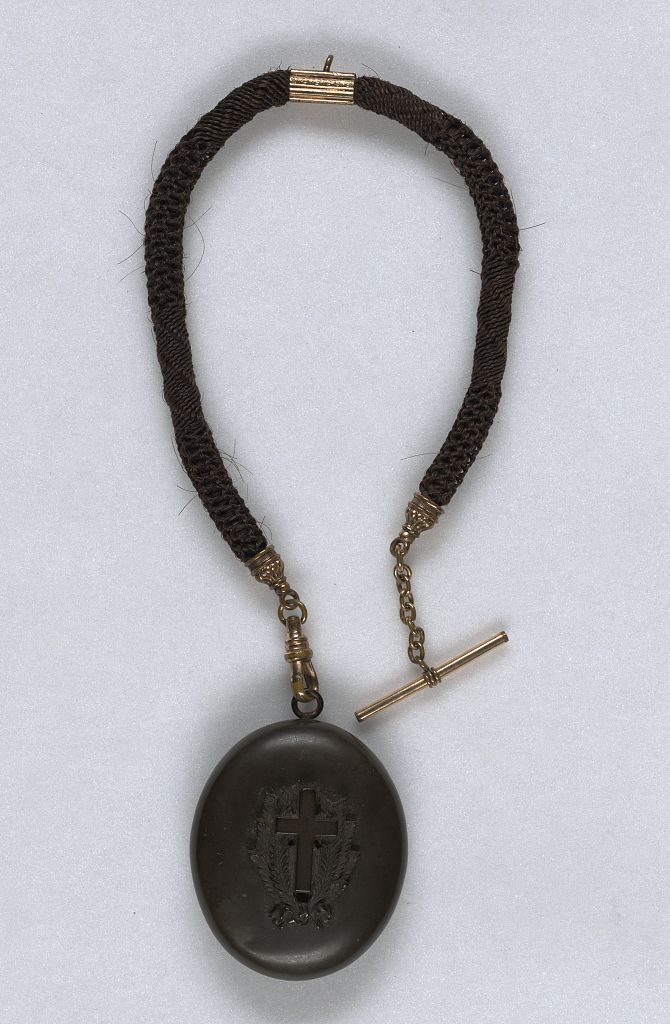
in locket with chain of braided hair, Library of Congress
Obverse, Library of Congress
Godey's Lady's Book of 1864 and 1865 seems in many cases almost reluctant to discuss mourning fashions, as if the grimness of the war had no place in a fashion magazine.  But there was definitely a demand for more information on the fashion of mourning and Godey's responded to it.  In August of 1864 in the "Chitchat" from the Fashion Editor, they write:
Information and suggestions on mourning dress and materials are desired by our readers, and we are pleased to give them the benefit of a letter on the subject from Mme. Demorest.
Bombazine is used now comparatively little for dresses.  Queen’s cloth, Yamise, Hernietta cloth, Barathea, all wool delaines, and merinos, are much preferred, as being more durable, handsomer, and still lusterless.  Alpaca is worn where trimming on the skirt is allowable; of course in deep mourning no trimming is used.
 For the heat of summer, such as we are now experiencing, black French grenadine, crape Maretz, and crape Eugene are the principal materials. 
Very elegant shawls are made of silk grenadine, with a fold a quarter of a yard wide of crape or silk.  Circulars are often made of the same material, trimmed with a fold of the same.  For fall, a fine black Thibet shawl edged with a wide fold of crape or silk is the most desirable. 
In bonnets, bombazine, crape Maretz, silk covered with crape, and all crape with crape ruche inside, are the only styles admissible for deep mourning. 
There is no dress that requires more discretion in the choice and arrangement than that called second mourning, but it is one of the most elegant, when well selected. 
For half mourning at this season of the year, Mme. Demorest is making black grenadine richly trimmed with flutings and silk, or ribbon quilled and laid on in various designs, while an endless variety of chene grenadines, lustrines, crapes, and Mozambiques, in black, gray, and lavender, give ample scope for a display of taste in all the gradations of mourning dress. 
Some very beautiful designs in shawls have been exhibited this summer, in black grenadine with a border composed of white and violet stripes edged with a heavy silk fringe. 
Basquines and circulars made in lusterless silk, and without trimming, are very much worn in light mourning. 
For a half mourning bonnet black tulle puffed and trimmed with violets; or, for full dress, white crape covered with black lace and trimmed with violet flowers and violet strings; the latter is very much admired as a reception bonnet. 
One of the most elegant bonnets we have seen this season was composed of a new material having the appearance of fine Tarleton and velvet woven together to form small diamonds; the bonnet was covered plain with the material, while a simple, trailing vine of black ivy leaves, veined with white, fell over the crown and cape inside, white and black flowers and white strings.
In February 1864, the "Chitchat" produces this interesting anecdote on mourning accessories:
A style for which we have no word of praise, but is much worn, is a string or double string of large black beads round the neck, worn over the paletôt or wrap.  They are graduated in size, the largest being the size of a very large marble, and they are of jet, glass, or imitation jet.  They are particularly fancied in mourning.
The soldier's memorial, Currier & Ives, Library of Congress
Bonnets were often featured that were suitable for later stages of mourning, although, like dresses, there were never (during the period of 1864-1865) features of a dress for full mourning.  Quite simply, to describe fashions of full mourning would have been in contradiction of its purpose.  There should be no fashion to intense grief.

In May 1864, they include this bonnet.

Godey's, May 1864, Providence Athenaeum
Their description:  Bonnet for second mourning.  The front of the bonnet is of black silk.  The crown is of a light lavender silk, covered with a network of black chenille. The bow on top of the bonnet is of lavender silk, edged with black velvet, and the ends embroidered and trimmed with black chenille.  The inside trimming is composed of white and black lace, and loops of lavender-colored ribbon.
In the same issue, they include this evening dress, the second figure from the left.

Godey's, May 1864, Providence Athenaeum
Their description:  Evening dress for second mourning.  Lavender-colored silk dress, with three crepe puffs on the edge of the skirt.  The over-skirt is a network of fine black chenille, finished with a very rich chenille fringe, which just reaches the crepe puffings on the skirt.  The corsage is low, and pointed both back and front.  The fichu is formed of white and black lace and lavender ribbons.  The coiffure is of black velvet and lavender daisies.
In the March 1865 "Chitchat", they write the following:
Dresses of black tulle, puffed, are very fashionable for persons in light mourning, or even those wearing gay colors.  They are also convenient and pretty for a watering place.  Among the many fanciful ways of trimming are the following:  Studding them all over with steel or white satin beads, or else applying silver leaves at intervals over the puffs.  Others, again, are composed of several skirts ornamented with white floss silk, darned in to represent blonde patterns. 
Fancy pins and arrows of all descriptions are worn in the hair, and some very pretty ones, formed of crochet work and jet, have appeared for mourning.
In July 1865, they include the following in their color fashion plate.

Godey's, July 1865, Providence Athenaeum
Their description:  Second-mourning costume.  Dress of black silk edged by a narrow ruffle and trimmed with two rows of lace and bead insertion.  The over-dress is of spotted black lace, worked with beads, and caught up and ornamented by large jet beads.  The corsage is low, and finished at the waist by a belt of black velvet edged with jet, and finished with a jet clasp.  The sleeves are short, and formed of a full puff of lace over black silk, and ornamented by loops of black velvet.  The neck is covered by a fancy fichu of black lace, trimmed with black velvet and beads.  Leghorn hat, trimmed with narrow black velvet, steel beads, and short plumes.
And in November 1865, the following, the first dress on the left.
Godey's, November 1865, Providence Athenaeum
Their description:  Costume for light mourning.  Dress of rich black silk, trimmed with thick cord and violet silk.  The corsage is made with long coat-tails, edged with cord, and turned over with violet silk.  The front of the corsage is of violet silk, arranged to simulate a vest.  The edge of the skirt is trimmed with thick cord, and every breadth is cut up and turned back with revers, the space being filled in by violet silk edged with a fluted ruffle.  The bonnet is of black silk, covered with figured net, and trimmed with loops of violet velvet.  The inside trimming consists of a blonde ruching and a tuft of velvet.
Mourning in the period was not completely humorless, as this joke from the September 1864 issue attests.
CUSTOMER. “A slight mourning hat-band, if you please.”
HATTER. “What relation, sir?”
CUSTOMER. “Wife’s uncle.”
HATTER. “Favorite uncle, sir?”
CUSTOMER. “Um—well, yes.”
HATTER. “May I ask, sir, are you mentioned in the will?”
CUSTOMER. “No such luck.”
HATTER (to his assistant, briskly)—“Couple o’ inches, John!”
Thanks as always is due to the wonderful Providence Athenaeum. Please visit their website and find out what a worthy organization this is!